TECHNOLOGY ALWAYS WINS
(AND WHY THAT SHOULD TERRIFY YOU)


A few weeks ago I was walking through the downtown of my hometown, Kansas City, when I saw a man sitting on a piece of cardboard, homeless, holding a sign in his left hand asking for money to eat. In his right hand, he was scrolling on an iPhone. He caught me looking, gave me a small nod, and went back to his screen.
My first thought was judgment. My second was shame about my judgment. My third was more of a chain of thoughts that haven’t stopped — a series of questions, many I can’t answer. The main one being: what does poverty even mean anymore?
That man was holding more information than every president before Clinton had access to, combined. He can video call anyone on Earth at the touch of a screen. He has a global positioning satellite map, a high-resolution camera that shoots stunning photographs and 4K video, and the entire Library of Congress at his disposal. And yet, he’s still sleeping on cardboard.
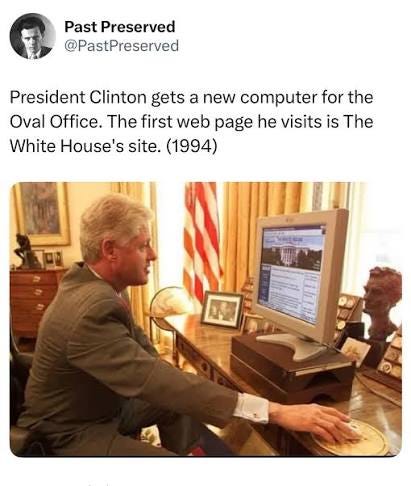
The old saying is true: technology wins. But what exactly does it win?
I’ve said the phrase a thousand times. It’s my reflex whenever someone tells me AI is going to end the world, or that we should have stopped at the telegraph. I say it because it’s true. Technology is relentless. It doesn’t care about your feelings or your union or your pension. It only cares about progress, and progress is defined as forward motion.
But lately I’ve wondered if I — and a lot of us — have been using the phrase to duck an extremely hard conversation.
I’ll be honest with you: I’m a little tired of writing about AI. I keep wanting to write about the other things I love, but I keep getting pulled back — as a maker, a business owner, an artist. It’s the water we’re all swimming in now, whether we like it or not. So let me try to say the true thing instead of the easy one.
THE CASE FOR TECHNOLOGY:
I remembered a clickbait headline I read a few months ago: “technology is the only thing that has ever reduced poverty.”
Before the printing press, books cost as much as houses. Knowledge belonged to the wealthy. Gutenberg didn’t just print Bibles — over the next few centuries he printed the middle class into existence. Before that press, the economic chasm was vast. The middle ground we all know so well didn’t exist. You were either wealthy or poor.
Before modern medicine, a third of children died before the age of five. That wasn’t a tragedy, that was a normal weekday. Now we’re annoyed when our prescription isn’t ready at the drive-through window.
And every time a machine arrives, the same panic arrives with it — and the panic is almost always wrong.
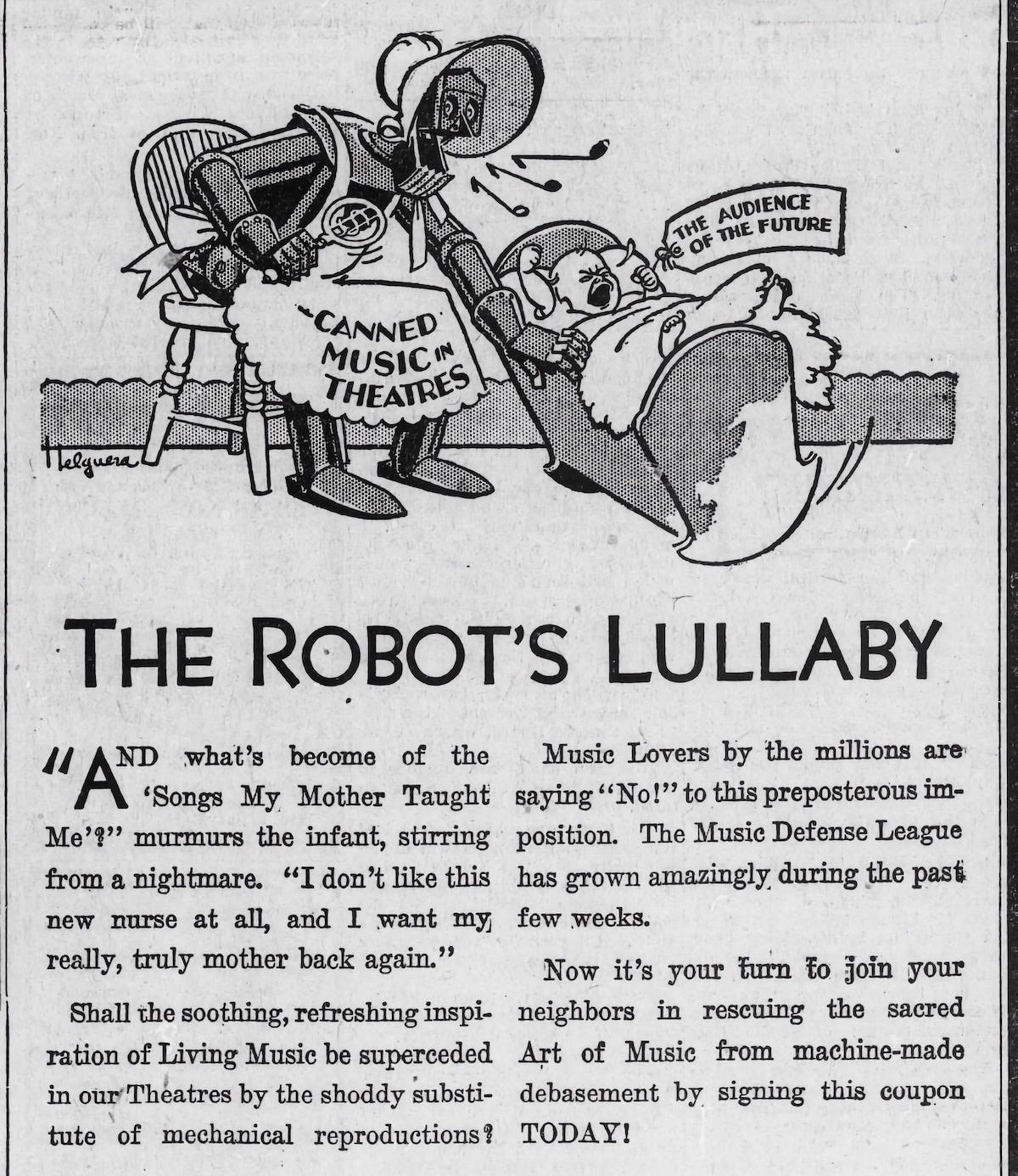
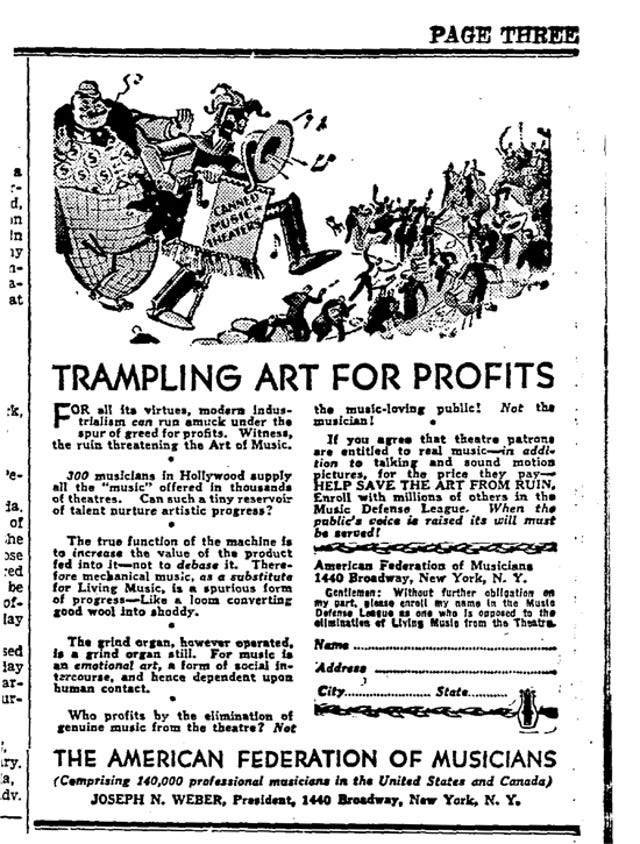
In 1927 the “talkies” landed, and within two years 20,000 theater musicians were out of work. The American Federation of Musicians spent over half a million dollars on an ad campaign begging the public to reject “canned recorded music,” complete with drawings of soulless robots playing violins. They lost. And that same recording technology went on to build radio, records, rock and roll, and a global music economy that employs more musicians than any era in history. The very people arguing right now about whether the band Geese is a psyop only have an entertainment economy to argue inside of because a technology their grandparents called the devil rebuilt the whole thing a hundred years ago. Nobody seems to check the rearview mirror for hypocrisy.
The ATM was supposed to kill the bank teller. In 1985 America had 60,000 ATMs and 485,000 tellers. By 2002 it had 352,000 ATMs and more tellers than before. The machine made branches cheap to run, so banks opened more of them, and the job quietly changed from counting cash to helping people. The technology didn’t erase the work. It revealed a different kind of it.
That’s the basic and proven pattern. Technology takes something scarce — knowledge, health, sound, labor — and makes it abundant. Abundance makes it cheap. Cheap means poor people can finally reach it. Messy and painful — the graph moves further up and to the right.
THE CASE AGAINST TECHNOLOGY:
Now the other side, because I’ve written on here before that better rarely wins a clean battle.
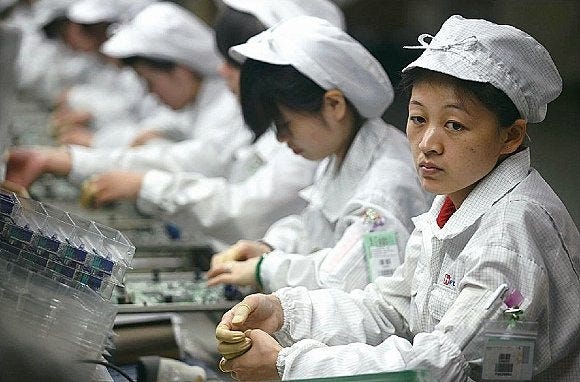
That iPhone in the man’s hand was designed by people making six figures in Cupertino and assembled by people making six dollars a day in Shenzhen. The same technology that “reduces poverty” often does it by moving poverty somewhere we don’t have to look at it.
We remember the Luddites as idiots smashing machines because they feared the future. They weren’t. They were skilled workers who understood the machines perfectly — they were protesting how factory owners used them to gut wages and put children at the looms. They weren’t wrong about what was coming. They were just standing where the loss actually landed.
That’s the uncomfortable version: technology doesn’t reduce poverty so much as it moves it — from one form to another, one population to another, one generation to the next. A lot of what we call poverty reduction is poverty redistribution with good marketing.
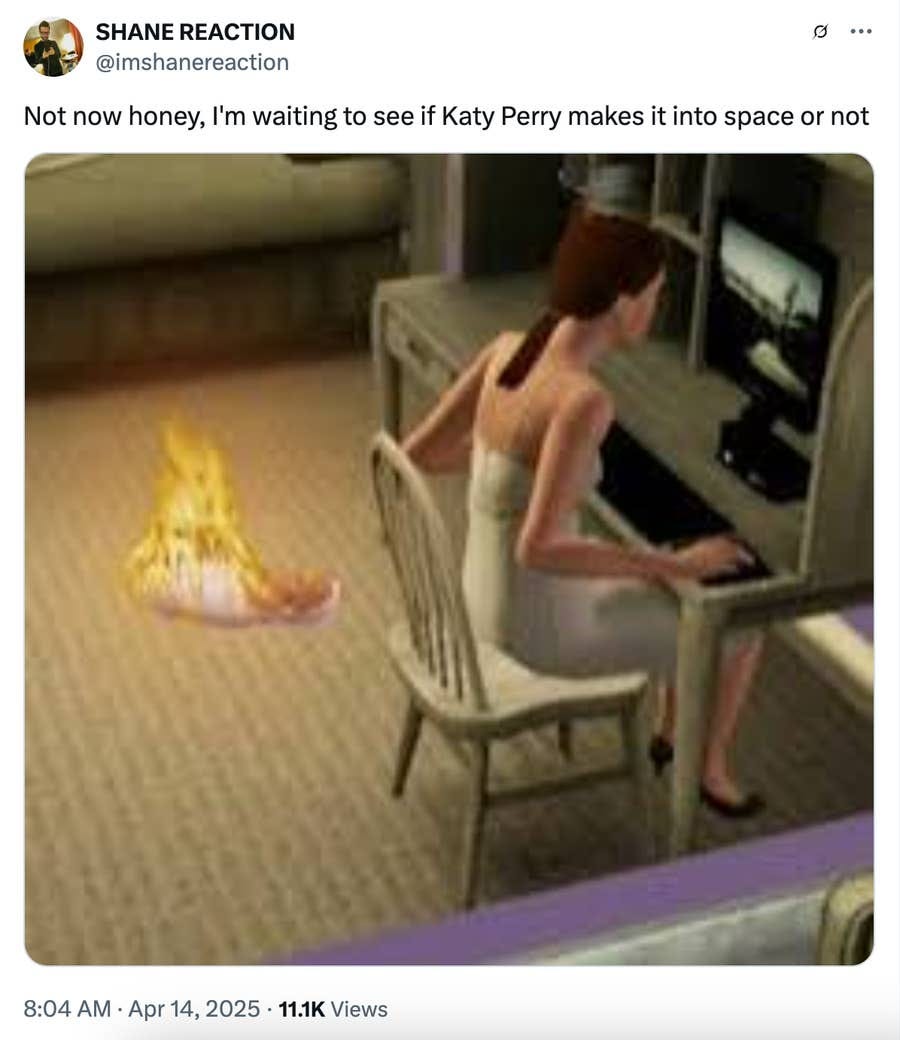
And the iPhone may be the cruelest turn yet. We handed everyone on Earth a window into how the other half lives, 24/7, in their pocket, with no way to climb through it to the other side. A man sitting on a piece of cardboard in 2026 can watch a pop star pay to float weightless for eleven minutes at the edge of space, sing a few bars of “What a Wonderful World,” and come home to applause. Our ancestors were just as poor — but at least they were spared this particular view of the life we’re now told is normal.
Here’s what I actually believe — what I settle on when I stop trying to win this argument.
Technology is not good or evil. It’s an amplifier. It takes whatever we already are and turns the volume knob up. Generous people get more generous, greedy people get more greedy, lonely people get more lonely. The printing press amplified Martin Luther’s Reformation and it amplified propaganda. The internet amplified education and it amplified lies. AI will do exactly what we decide to do with it, only much louder than we have ever seen before.
Which is why the certainty on both sides is the tell. “AI will destroy everything” is lazy. “AI will save everything” is lazier. If you’re scared of AI, you’re paying attention. If you’re excited about AI, you’re paying attention. If you’re certain about AI — certain it’s all one thing — you’re wrong.
E. M. Forster saw it coming in 1909, when “The Machine Stops” imagined people sealed in private pods, talking only through screens, worshipping the machine that was hollowing them out.
Neil Postman saw it coming in 1985, when “Amusing Ourselves to Death” warned we’d be undone not by what we fear but by what we love.
Joseph Weizenbaum saw it coming in 1976, when the man who built the first chatbot spent the rest of his life begging us not to mistake it for understanding.
Ray Kurzweil saw it coming in 1999, when “The Age of Spiritual Machines” predicted the machines would convince us they were conscious by 2029.
The writers and thinkers who get there first aren’t prophets of doom — they’re just people willing to sit inside the discomfort of the possible future and tell us what they feel.
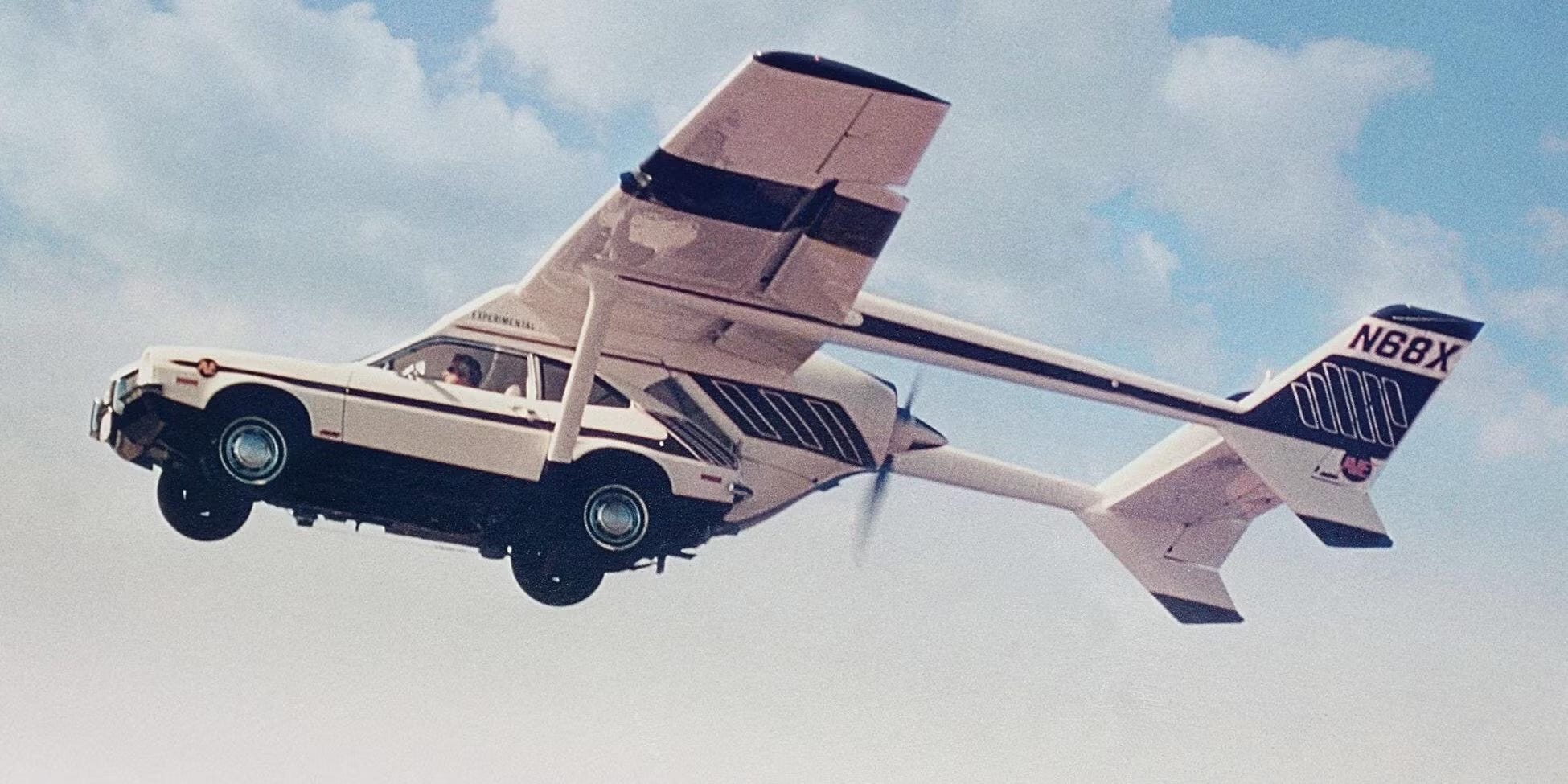
I grew up in the 80s and 90s, when the future was supposed to be jetpacks, flying cars, and robot butlers. Instead we got algorithms that know we’re pregnant before we do, and devices that can reach anyone and still somehow leave us lonely.
Technology won. It just wasn’t the game we thought we were playing.
So the next time you catch yourself saying technology will ruin everything, or save everything — stop. Ask what you actually mean. Ask who benefits. Ask who pays. Ask what your certainty is actually saying about your ideals and your beliefs. It’s never as simple as they want you to believe.
Because technology doesn’t have a soul.
It doesn’t care about poverty or justice or cruelty.
We do.
Or at least we are supposed to.
And that’s the most terrifying thing about what might be coming.
If you enjoyed this, consider grabbing a copy of my new book Made On Earth For Rising Stars: The Story Of Electro-Harmonix. Every sale matters. It tells my publisher and distributer that people like you care about books like this. Also, my content here is always free, but if you subscribe with any payment, 100% goes to my local non-profit art center where we teach kids music and art for free. www.arthousegrandview.com

[article written entirely by Google Gemini] 😜
Seriously though, technology DOES always win. We are just witnessing it happen at a pace never before seen. To survive this technological adolescence (Jodie Foster line in Contact), I feel like society needs start moving toward a "Star Trek" economy where human value is no longer tied strictly to labor or other measure of “output”.
There is a heartbreaking irony in watching my 12-year-old daughter look at the future, not with a sense of wonder, but with a strategy for survival. She is already trying to identify career paths they will be “AI-proof”. As far as I can tell, it seems like the skilled trades are the only safe haven left, at least until robotics catches up to the software.
We are essentially asking our kids to win a race against an exponential curve. But we are no longer just building tools to assist us or make us more efficient. we are actually building the tools that will succeed us.
IMO the deeper crisis here isn't economic, it's existential. For centuries, we have defined human worth by what we produce. If we don't decouple our sense of purpose from our productivity, the greatest casualty of the automation age won't be our livelihoods, it will be our identity.
Technology brings us all sorts of things, but we have a tendency to misuse it - and then we are upset with the results. I mean, you can do a lot of things with a screwdriver, but it’s best at just driving screws, ya know? We tend to not read instructions.